
AI Agents in Robotics: How Intelligent Robots Will Work, Reason and Act
Robotics has always been about giving machines the ability to perform physical tasks. From industrial robotic arms assembling cars to autonomous machines moving products through warehouses, robots have already transformed many industries.
But the next stage of robotics is different.
Instead of programming a robot to perform every task in advance, researchers and technology companies are working toward robots that can understand instructions, recognize what is happening around them, make decisions, and adapt their actions when conditions change.
This is where AI agents in robotics are becoming increasingly important.
An AI agent can give a robot a higher level of intelligence. Rather than simply following a fixed sequence of commands, the robot can be given a goal and determine how to work toward that goal.
For example, imagine telling a warehouse robot:
“Find the damaged packages in this area and move them to the inspection section.”
The instruction sounds simple to a person. For a robot, however, it involves a surprisingly large number of decisions. It needs to identify the correct area, recognize packages, determine which ones may be damaged, navigate safely, pick them up, transport them, and confirm that they reached the correct destination.
This ability to understand a task and work through the required actions is at the heart of the growing relationship between artificial intelligence and robotics.
What Is Agentic AI in Robotics?
Agentic AI in robotics refers to artificial intelligence systems that can pursue a goal, make decisions, interact with their environment, and take actions through a physical robot.
Traditional robots are generally built around clearly defined instructions. Engineers program a particular sequence of movements, conditions, and responses. This approach works extremely well when the environment is predictable.
The real world is rarely predictable.
Objects can move. People can enter a robot’s workspace. Lighting can change. A package may not be where the system expects it to be. A robot may fail to grasp an object on its first attempt.
An agentic system is designed to deal with some of this uncertainty.
Instead of telling a robot exactly how to complete every part of a task, a person can describe what needs to be accomplished. The AI system can then interpret the request, examine the environment, plan an approach, perform the task, and use feedback from the robot to decide what should happen next.
This does not mean that robots suddenly have human-level intelligence. It means that robotics software is moving toward systems that can make more decisions at a higher level.
From Programmed Machines to More Adaptive Robots
Traditional robotics remains extremely important.
Industrial robots are highly successful because they can perform repetitive operations with speed, accuracy, and consistency. A robot arm working on a production line can repeat the same movement thousands of times without becoming tired.
The problem appears when the task changes.
If the objects being handled are different, the environment changes, or the workflow becomes more complicated, traditional systems may require additional programming and engineering.
Artificial intelligence offers another approach.
Modern AI systems can recognize objects, understand images, process natural language, and make decisions based on complex information. When these capabilities are connected to robotics, machines can potentially handle a much wider range of situations.
The result is a shift from highly specific robotic automation toward more flexible and intelligent automation.
The goal is not to eliminate traditional robotics. Instead, AI can work alongside existing robotics technologies to give machines a greater ability to understand and respond to their surroundings.
How AI Agents Give Robots Greater Intelligence
A useful way to think about an AI agent is as an intelligence layer between a person’s objective and a robot’s physical capabilities.
A person might tell a robot to prepare a room, inspect a production line, deliver a package, or move a group of products.
The agent has to understand what the person means and determine what information and capabilities are required to accomplish the task.
It may need to look through cameras, access a database, use a navigation system, communicate with another machine, or ask a human for clarification.
The robot then performs the physical work and provides new information through its sensors.
This creates an ongoing interaction between the AI system and the physical environment.
The important difference is that the robot is not necessarily expected to follow one rigid sequence from beginning to end. It can use new information as the task progresses.
Giving Robots the Ability to See and Understand
A robot cannot make useful decisions about the physical world without information about its surroundings.
This is why computer vision and other sensing technologies are so important to AI-powered robotics.
Modern robots can use cameras, depth sensors, LiDAR, microphones, force sensors, tactile sensors, infrared sensors, and other technologies to understand their environment.
A camera might show a robot that there is a box on a table. But an intelligent robotic system needs to understand much more than simply recognizing the object.
It may need to determine where the box is, whether it can safely be picked up, whether something is blocking it, whether a person is nearby, and where the box should go.
This type of environmental understanding is becoming increasingly sophisticated as computer vision models and multimodal AI systems improve.
The combination of visual information and reasoning is particularly important for robots because the physical world contains far more variation than a controlled software environment.
Natural Language Could Become a New Way to Control Robots
One of the most interesting possibilities is the use of natural language to communicate with robots.
Robotics has traditionally required specialized programming knowledge. Engineers and operators often need to understand the robot’s hardware, software, sensors, motion planning, and control systems.
AI agents could make interaction much more accessible.
A worker might say:
“Bring the blue container from the storage area.”
A warehouse manager could say:
“Prepare the urgent orders first.”
A factory operator might ask:
“Inspect these products and separate anything that looks damaged.”
The robot does not simply repeat the words it hears. It has to understand the intention behind the instruction and translate it into physical actions.
This could eventually make robots easier for non-specialists to use.
Instead of learning how to program every robot, workers could interact with machines through familiar language.
Planning Is One of the Most Important Capabilities
Understanding a request is only the beginning.
A robot also needs to determine how to accomplish it.
Consider a simple instruction:
“Prepare the meeting room.”
For a person, this could mean arranging chairs, cleaning the table, removing rubbish, checking equipment, and making sure everything is ready.
For a robot, each of those activities represents a separate challenge.
The system has to understand the environment, identify what needs to be done, determine which actions are possible, and decide what order makes sense.
This is where AI-based planning becomes valuable.
An agent can break a larger objective into smaller tasks and decide which capabilities are needed for each part of the job.
If something changes during the process, the plan can potentially be adjusted.
This ability to reconsider a task rather than simply stopping after the first unexpected event is one of the reasons agentic AI is attracting so much attention in robotics.
Vision-Language-Action Models Are Changing Robotics
One of the important areas of research in this field is the development of Vision-Language-Action models, often referred to as VLAs.
These models are designed to connect visual information, language instructions, and physical robot actions.
A conventional vision model might identify a cup.
A language model might understand the instruction:
“Pick up the cup.”
A vision-language-action system attempts to connect these capabilities so that the robot can understand the scene and perform the appropriate physical action.
Google’s RT-2 research was an important demonstration of this idea. It explored how knowledge from vision-language models could be transferred into robotic control, helping robots respond to new objects and instructions.
Since then, research into VLA systems has expanded considerably.
OpenVLA is another example of research toward more general-purpose robot policies. The project explored training a large vision-language-action model using a large collection of real-world robot demonstrations.
The broader objective is to create models that can generalize across more tasks and situations rather than requiring a completely separate model for every robotic application.
AI Agents and VLA Models Are Different
Although the terms are sometimes used together, an AI agent and a VLA model are not exactly the same thing.
A VLA model is primarily concerned with connecting visual and language information to physical robot actions.
An AI agent can operate at a broader level.
An agent may decide what task needs to be performed, retrieve information from another system, use a vision model, call a robot API, use memory, create a plan, and then rely on a robotic policy to execute the physical portion of the task.
For example, consider a warehouse where a manager asks the system to prepare urgent orders.
The agent could first check the order management system, determine which products are required, check inventory, identify where those products are located, and assign tasks to robots.
The robot’s action model then handles the physical movement and manipulation.
This layered approach is likely to become increasingly important as robotics and AI develop.
Memory Could Make Robots More Useful
Memory is another important part of agentic systems.
Imagine a service robot working inside a large building.
If it learns where particular objects are normally stored, it can use that information when performing future tasks.
A robot operating in a warehouse could remember which areas have already been inspected, which products were missing, or which locations are frequently used.
Memory can also help robots maintain context during longer tasks.
Instead of treating every instruction as an isolated event, an intelligent system can use information from previous interactions and previous experiences.
However, robotic memory must also be carefully designed. Storing information about people, homes, workplaces, or sensitive environments creates privacy and security considerations that developers need to take seriously.
Robots Will Need to Work With Other Software
The most useful robotic agents will not operate in isolation.
Businesses already depend on many digital systems, including inventory software, enterprise applications, warehouse management systems, scheduling platforms, customer databases, and monitoring tools.
An AI agent can potentially connect these digital systems with physical robots.
Consider an e-commerce warehouse.
A customer places an order. The system checks inventory, identifies the product location, assigns a robot, retrieves the item, verifies it, sends it to packing, updates inventory, and reports the status.
The robot is only one part of the overall workflow.
The AI agent can coordinate the different systems involved.
This is where agentic robotics could become especially valuable for businesses. The opportunity is not simply to create smarter machines, but to connect physical automation with the digital systems that already run an organization.
Agentic AI in Warehouse Robotics
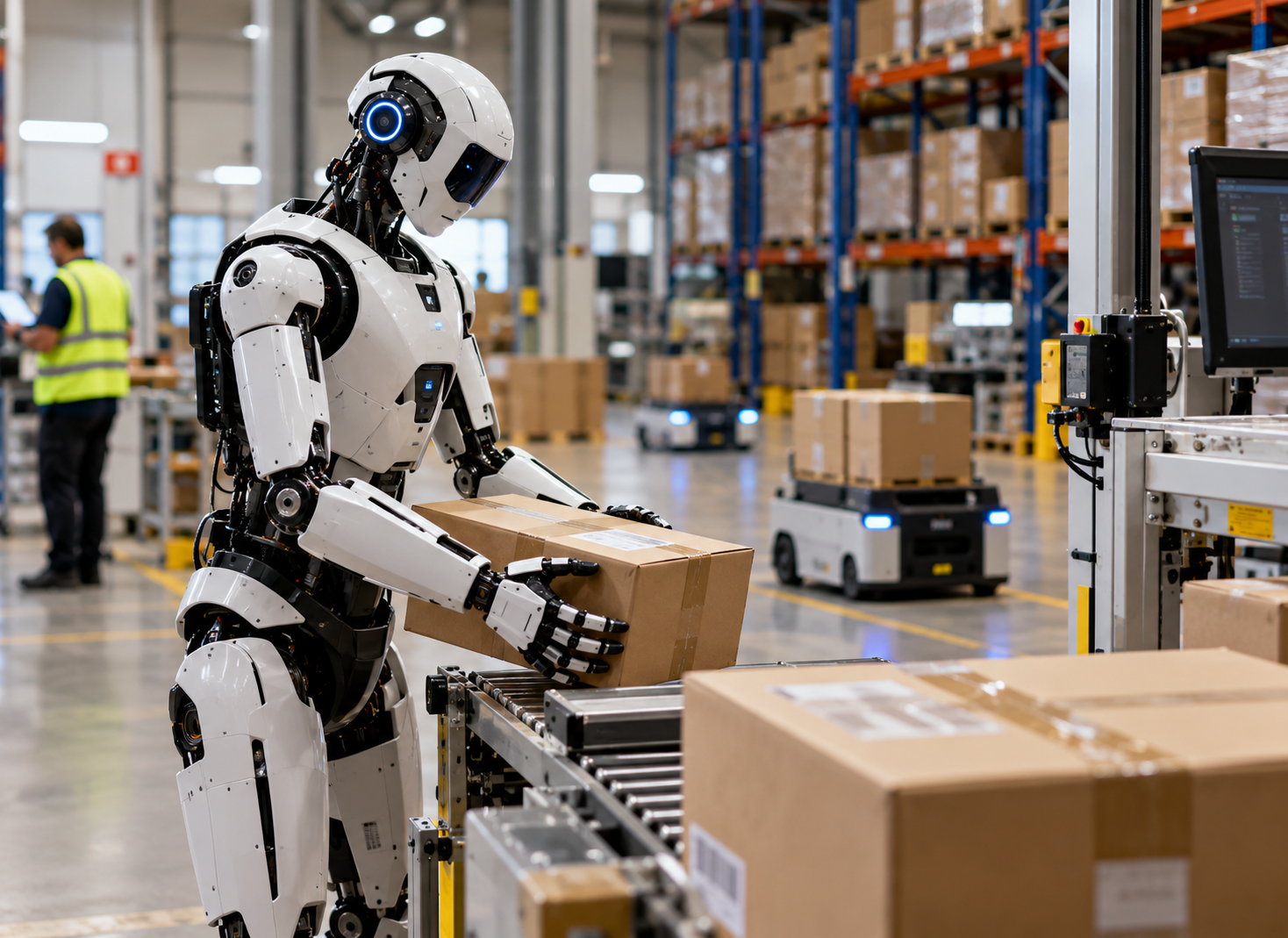
Warehousing is one of the strongest potential applications for intelligent robotic agents.
Modern warehouses already use autonomous mobile robots, robotic arms, conveyors, computer vision, barcode scanners, and warehouse management software.
The next step is making these systems work together more intelligently.
A manager could eventually give an instruction such as:
“Prepare today’s priority shipments and make sure all missing items are identified.”
An agent could analyze orders, check inventory, locate products, coordinate available robots, monitor progress, verify results, and report problems.
If one robot becomes unavailable, the system could potentially reassign work to another available machine.
This kind of coordination is one of the clearest examples of how agentic AI could improve existing automation.
Agentic AI in Manufacturing
Manufacturing is another area where intelligent robotics could have a significant impact.
Factories already use robotic arms for welding, assembly, painting, packaging, inspection, and material handling.
AI agents could help coordinate these systems and make automation more flexible.
For example, a factory could use computer vision to inspect products while robotic systems handle physical movement.
An AI system could analyze inspection results, identify patterns, flag unusual products, and connect the findings with manufacturing software.
This could help manufacturers move toward more adaptive production environments.
Rather than building a completely separate workflow for every small variation, AI could help systems respond to changing requirements.
Agentic AI in Healthcare Robotics
Healthcare is another important application, although it comes with much stricter requirements.
Robotics is already being used in areas such as surgery, rehabilitation, hospital logistics, disinfection, pharmacy automation, and patient assistance.
AI agents could potentially help coordinate some of these activities.
For example, a hospital logistics system could receive a request to deliver medical supplies to a particular department. An intelligent system could determine which robot is available, plan a route, monitor the delivery, and update the relevant system when the task is completed.
However, healthcare robotics requires a much higher level of caution than many commercial applications.
Patient safety, privacy, cybersecurity, clinical validation, regulatory requirements, and human oversight are essential.
AI agents may assist healthcare professionals, but high-risk medical decisions should not simply be handed over to an autonomous system.
Agentic AI in Agriculture
Agriculture presents another interesting challenge for robotics.
Farms and agricultural environments are highly variable. Weather, terrain, crops, lighting, soil conditions, and plant growth can change constantly.
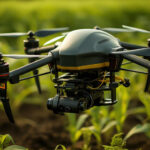
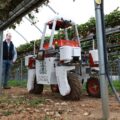
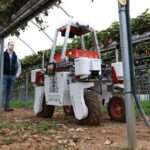
Robotic systems are being developed for crop monitoring, weed detection, harvesting, spraying, and other agricultural tasks.
AI agents could potentially coordinate these systems by interpreting sensor data, identifying areas that require attention, planning robotic operations, and adjusting tasks as conditions change.
Agricultural robotics demonstrates why physical AI needs to be adaptable.
A robot operating in a controlled factory can work with relatively predictable conditions. A robot operating outdoors has to deal with a much more complicated environment.
Humanoid Robots and Agentic AI
Humanoid robots have become one of the most visible areas of robotics research.
There is a practical reason for this interest.
Human environments are designed for human bodies.
We use doors, stairs, shelves, tables, tools, kitchens, warehouses, factories, and vehicles that are generally designed around human dimensions and capabilities.
A humanoid robot could potentially operate in these environments without requiring major changes to existing infrastructure.
But building a useful humanoid robot requires far more than creating a machine with two arms and two legs.
It needs to understand its surroundings, maintain balance, navigate spaces, manipulate objects, communicate with people, and make decisions.
This is why advances in AI are closely connected to the development of humanoid robotics.
The physical body provides the capabilities, while increasingly sophisticated AI models provide perception, reasoning, learning, and task understanding.
Robot Foundation Models
Another major development is the emergence of robot foundation models.
The concept is similar to the foundation models used in language and computer vision.
Instead of creating an entirely separate model for every robotic task, researchers are exploring models trained on large and diverse collections of robotic experiences.
These models can learn relationships between what a robot sees, what it is asked to do, and how it should move.
Companies and research organizations are investing heavily in this area.
NVIDIA’s GR00T initiative, for example, focuses on foundation models for humanoid robots and physical AI.
Google DeepMind is also developing robotics models designed to connect advanced AI capabilities with physical robots.
These efforts indicate a broader shift toward general-purpose robotic intelligence.
Robotics Data Is Becoming Extremely Valuable
One of the biggest challenges in AI robotics is data.
Language models can learn from enormous quantities of text available on the internet.
Robots do not have an equivalent amount of easily available physical-world training data.
A robotic training example might include camera images, robot positions, movements, instructions, and information about whether the task succeeded.
Collecting this information requires real robots, operators, sensors, and carefully designed experiments.
That makes high-quality robotics data expensive.
Researchers are therefore exploring teleoperation, demonstrations, simulation, synthetic data, reinforcement learning, and other techniques to increase the amount of training information available.
The quality of this data is just as important as the quantity.
A model needs to experience not only successful actions but also unusual situations and failures.
Simulation Could Accelerate Robot Development
Physical robots are expensive to operate continuously.
Simulation provides a way to test and train robotic systems in virtual environments.
Developers can create virtual warehouses, factories, homes, farms, and other environments and allow robots to practice tasks repeatedly.
Simulation can help developers test:
- navigation
- manipulation
- object recognition
- collision avoidance
- different environments
- unusual situations
- large numbers of scenarios
However, simulated environments are never perfectly identical to reality.
Real-world objects have unpredictable properties. Sensors contain noise. Mechanical components behave differently. People move unpredictably.
This difference is commonly referred to as the sim-to-real challenge.
Successful robotic AI systems will therefore need both simulation and extensive real-world testing.
Safety Will Remain a Critical Issue
As robots become more autonomous, safety becomes increasingly important.
A software agent making an incorrect recommendation is one thing.
A physical robot making an incorrect movement is something very different.
A robot could damage equipment, drop an object, collide with a person, or interfere with an industrial process.
For this reason, AI should not be treated as the only safety mechanism.
Robotic systems still require dedicated safety controls, emergency stops, collision detection, speed restrictions, physical boundaries, monitoring systems, and other safeguards.
The AI agent can make decisions, but the robot needs independent mechanisms that prevent dangerous actions.
Human supervision will also remain important for many applications, especially in healthcare, industrial environments, and other areas where mistakes can have serious consequences.
Cloud AI and AI Running on Robots
Another question facing robotics developers is where the AI should run.
Large AI models can require significant computing power.
Cloud infrastructure can provide access to powerful models, but robots cannot always depend on a stable internet connection.
A delay of several seconds might be acceptable for a planning task but completely unacceptable for a fast physical movement.
This is why many future robotic systems are likely to use a combination of cloud and local computing.
A robot may handle fast perception and immediate actions locally while using cloud systems for larger planning tasks, analytics, model updates, and long-term knowledge.
The exact balance will depend on the application.
The Biggest Challenges Ahead
Despite rapid progress, agentic robotics still faces significant challenges.
Reliability remains one of the biggest problems.
A robot cannot be considered commercially useful simply because it completes a task successfully in a demonstration. It needs to perform reliably thousands of times under real-world conditions.
Generalization is another major challenge.
A model trained on one environment may behave differently when it encounters unfamiliar objects, lighting conditions, surfaces, or layouts.
Physical reasoning is also difficult.
The real world follows physics, and language alone cannot fully describe every physical situation.
There are also challenges around computing power, latency, hardware costs, cybersecurity, privacy, regulation, and the availability of high-quality training data.
These challenges will take years of research and engineering to solve.
What Agentic Robotics Could Mean for Businesses
The most important question for businesses is not whether a robot looks impressive.
The important question is whether it can solve a real problem.
A company considering robotics should begin by examining its existing workflows.
Which tasks are repetitive?
Which processes are expensive?
Where are employees spending time on physically demanding work?
Which tasks require inspection or movement?
Where could automation improve speed, quality, or safety?
Once the problem is understood, the company can determine whether robotics, AI, or a combination of technologies makes sense.
This approach is more practical than starting with a particular robot and then trying to find a use for it.
The future of robotics will likely be driven by companies that can connect AI capabilities with measurable business outcomes.
The Future of AI Agents in Robotics
The long-term vision for agentic robotics is not simply a robot that understands a voice command.
It is a machine capable of understanding a broader objective, working through a complex task, using its available capabilities, and adapting when the physical environment changes.
Imagine a future warehouse where a manager does not need to manually assign every robotic task.
Instead, the manager describes the day’s priorities.
The AI system understands the business objectives, checks available inventory and robots, creates a plan, coordinates the work, monitors progress, and alerts people when something requires attention.
A similar concept could apply to factories, hospitals, farms, retail stores, construction sites, and eventually homes.
This would represent a major change in how people interact with automation.
Instead of thinking about robots as individual machines, businesses could begin thinking about them as part of an intelligent workforce that combines humans, software, and physical machines.
Conclusion
The development of AI agents could become one of the most important changes in robotics in the coming years.
Traditional robotics gave machines the ability to perform physical tasks with remarkable precision. Artificial intelligence is now giving those machines increasingly sophisticated abilities to understand their environment, process information, interpret instructions, and make decisions.
Vision-language-action models, robot foundation models, computer vision, machine learning, simulation, and increasingly capable hardware are all contributing to this development.
However, building useful physical AI is not simply a matter of connecting a large language model to a robot.
Successful systems will require strong robotics engineering, reliable sensors, accurate control systems, high-quality training data, extensive testing, carefully designed safety mechanisms, and appropriate human oversight.
The most important change may be the shift from robots that simply execute predefined instructions toward robots that can understand what people are trying to accomplish and determine how to help achieve that objective.
That future is still developing, and many technical challenges remain.
But the direction is clear.
Robotics is moving from machines that simply perform programmed tasks toward intelligent physical systems that can understand, decide, act, and adapt.
And as AI agents become more capable, the relationship between humans and robots could change from programming individual machines to working with intelligent robotic systems that can participate in entire workflows.
That may ultimately be the real promise of agentic AI in robotics: not just smarter robots, but a new way for people and machines to work together.